|
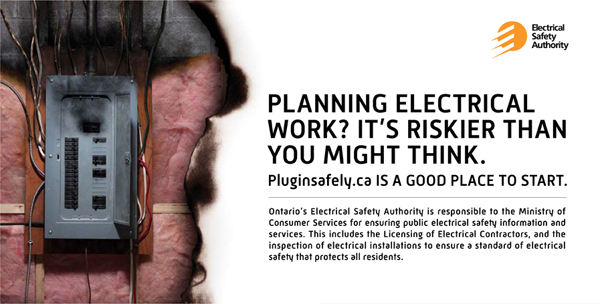
Visit The ESA for all the detailed information.
Wiring safety codes are intended to protect people and property from electrical shock and fire hazards. Regulations may be established by city, county, provincial/state or national legislation, usually by adopting a model code (with or without local amendments) produced by a technical standards-setting organization, or by a national standard electrical code.
Electrical codes arose in the 1880s with the commercial introduction of electrical power. Many conflicting standards existed for the selection of wire sizes and other design rules for electrical installations.
Since 1927, the Canadian Standards Association (CSA) has produced the Canadian Safety Standard for Electrical Installations, which is the basis for provincial electrical codes. The CSA also produces the Canadian Electrical Code, the 2006 edition of which references IEC 60364 (Electrical Installations for Buildings) and states that the code addresses the fundamental principles of electrical protection in Section 131. The Canadian code reprints Chapter 13 of IEC 60364, but there are no numerical criteria listed in that chapter to assess the adequacy of any electrical installation.
|